Brand Identity as a System: A Guide for Indian Retail Brands in 2026
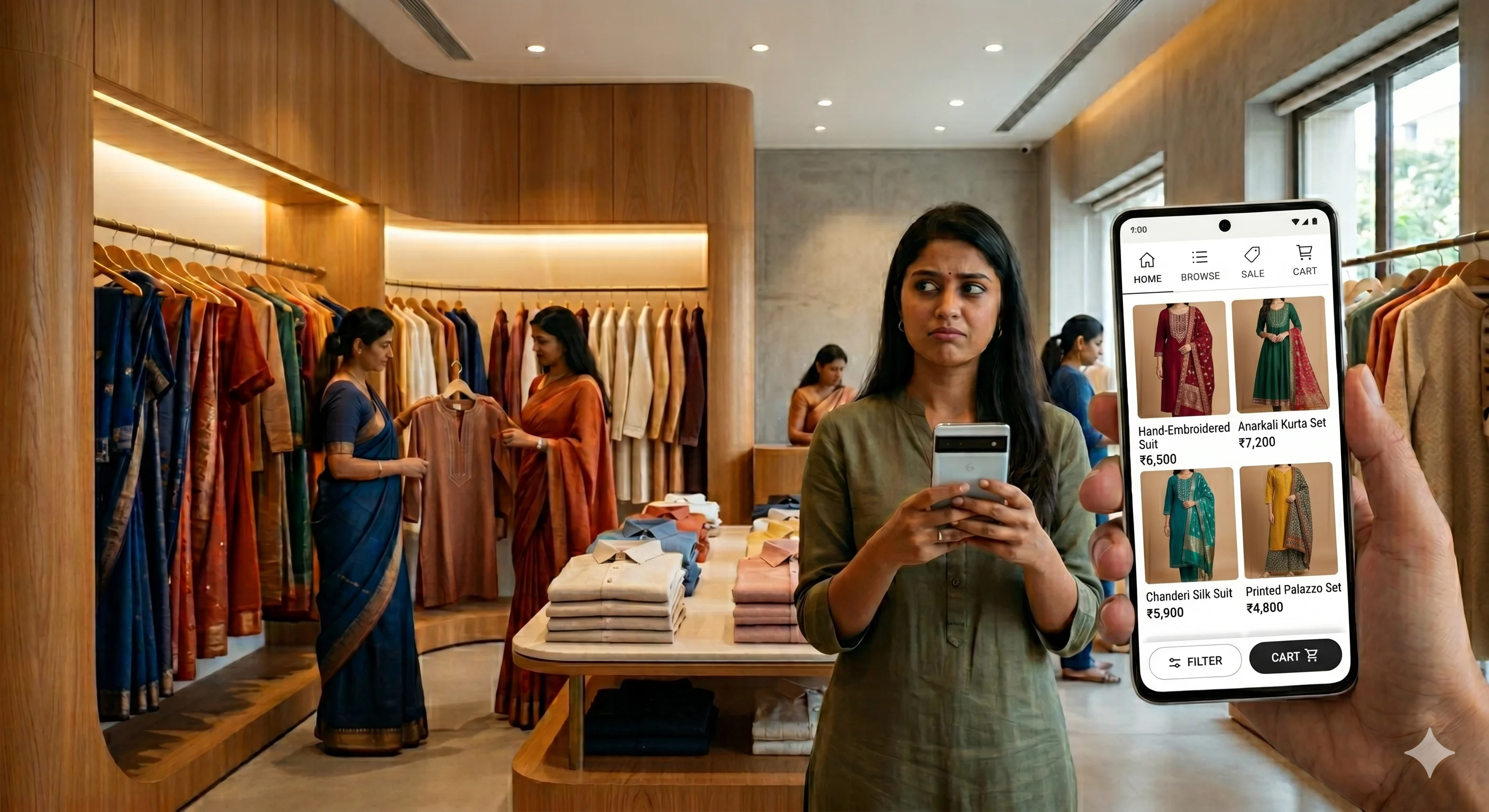
Your physical store earns its place. The fixtures are deliberate, the lighting is considered, the staff know the product. A customer walks in, feels something, and decides to trust you. Then they pull out their phone to check your website before completing the purchase. What they find looks like it was built by a different company on a different day with a different brief.
The Store Is Beautiful. The Brand Stops at the Door.
Your physical store earns its place. The fixtures are deliberate, the lighting is considered, the staff know the product. A customer walks in, feels something, and decides to trust you. Then they pull out their phone to check your website before completing the purchase. What they find looks like it was built by a different company on a different day with a different brief.
That is the brand identity problem most Indian retail teams are not measuring, because it does not show up cleanly on any dashboard. It shows up as a customer who walked in, felt unsure, and walked out.
This post names the consensus belief that is creating this gap, argues for the shift that closes it, translates that shift into what your team actually has to do differently, and diagnoses the single failure mode that stops most brands from acting. Three sections of argument, one concrete action.
The Consensus That Is Quietly Failing You
Most brand teams treat physical and digital as parallel tracks. The store gets a design budget, an agency brief, a rollout plan, and a refit cycle. The digital store gets a template, a product feed, and a developer. The belief running underneath this split is reasonable: physical is experience, digital is utility. Let each channel do what it is good at.
That belief made sense in 2018. It is breaking now.
According to the research, 60 to 65 percent of Indian consumers now expect physical and digital to feel like one brand, not two separate operations running under the same logo. The mechanism of failure is specific. When a customer's in-store experience creates a brand impression and the digital touchpoint directly contradicts that impression, the trust built in the store does not transfer. It evaporates. The brand work done at the most expensive cost per square foot in your property portfolio gets cancelled by a generic product listing page.
Strong physical presence, weak digital expression, and the market reads the gap as a sign the brand does not take itself seriously online. That is a brand perception problem, not a technology problem.
The Shift: Identity Is an Operating System, Not a Presence
The brands closing this gap are doing something structurally different. They are treating brand identity as a system that governs decisions across every surface, rather than a set of assets applied separately to each channel.
This is not a philosophical point. It is operational. A system answers the questions a creative team needs to answer on a Tuesday: what does our voice sound like in a product description? What visual behaviour belongs on a mobile product page that also belongs on an in-store display? What does not belong anywhere?
Here is what this looks like in practice. A mid-sized Indian fashion retailer we worked with came to us with exactly this split. Their flagship stores in Mumbai and Pune had strong visual language and a clear brand character. Their digital store, including product pages, WhatsApp Business catalogues, and Instagram Shopping feeds, used whatever template was available. We built a single identity architecture that defined type hierarchy, photographic behaviour, tone registers, and colour application rules for both environments. The team applied it to all digital surfaces inside one quarter. The behavioural change was measurable: the volume of internal creative approvals that required escalation dropped by 60 percent, because the system answered most questions before they reached a decision-maker. The brand stopped being rebuilt from scratch every time a new channel appeared.
What This Means for Your Brand Budget
The operational implication is uncomfortable: most Indian retail brands are spending on two separate brand-building exercises without realising it. Physical store design money and digital creative money are both being spent, but they are producing separate impressions that partially cancel each other out.
The shift in practice means the design brief for your next store refit and the brief for your next website or app refresh should originate from the same identity system. This is not about making everything look identical. It is about making every surface feel like a deliberate extension of the same thinking.
A fast-growing home furnishings brand in Ahmedabad brought us a specific problem: their retail showrooms had a distinctive material and craft story, but their Flipkart and Amazon listings used stock photography and generic category copy. Marketplace conversion on their top-margin SKUs was running below category average. We rebuilt the listing content, photography direction, and copy voice to carry the same craft narrative the physical showroom delivered. Within eight weeks of relaunching the A+ content and updated imagery, conversion on those SKUs improved by 22 percent. The store's brand character had always been the competitive advantage. It just was not present where the purchase decision was actually being made.
The Failure Mode That Will Kill This Before It Starts
Most teams that recognise this problem do not act on it. They talk about it in a quarterly review, someone creates a presentation about brand consistency, and the next week the developer updates the product template because it was faster.
The failure mode is specific. Teams treat identity consistency as a design task rather than a governance task. They commission a new logo guidelines document or run a brand refresh and assume the output is a PDF that lives on Google Drive. It is not. A brand identity system is only doing its job if the people making daily creative decisions are using it without being asked to. That means it has to answer practical questions quickly. It has to be built for the people executing Instagram Shopping assets and WhatsApp Business messages, not just for the agency presenting the pitch deck.
The brands that will close the gap in the next 12 months are the ones that treat identity governance as an operational discipline. The ones that will still be talking about it are the ones waiting for a brand refresh project to solve what is actually a daily decision problem.
The One Identity Audit Worth Running Before June Ends
Pick six surfaces where your brand is currently active: your store frontage or signage, your website homepage, a product listing page on a marketplace, an Instagram Reel from last month, a WhatsApp Business message sent to customers, and a piece of packaging or a carry bag.
Print or pull them up side by side. Ask one question for each: does this look and sound like it was made by the same team with the same brief?
If more than two of the six feel like they came from different companies, you have an identity system problem, and it is actively working against the trust your physical store is building. That audit takes two hours. What you do with it is a strategic decision. But you cannot make the decision if you have never looked at the six surfaces at the same time.
If your audit surfaces more gaps than you expected, that is the starting point for a conversation we are built to have. Write to us at [email protected] with what you found.
Ready to Turn Your Brand Identity Into a System That Holds?
We work with Indian retail brands to build identity systems that govern creative decisions across physical stores, marketplaces, social channels, and every surface in between. One team, one brief, every channel.
Bring your audit. We will tell you exactly what to fix first. Write to us at [email protected].
Get Your A+ Content Audit Started
If you want to see exactly which listings in your catalogue are losing conversions right now, and what the rebuild would actually cost and return, write to us at.
Ready to elevate
your brand?
Drop us a message, and let’s start
building something amazing together.