Digital Signage for Indian Retail: 2026 Playbook
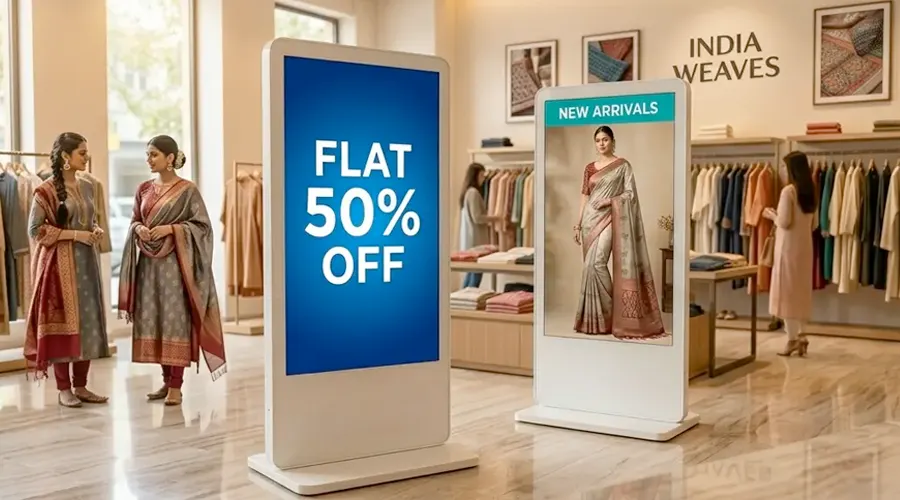
What the Numbers Inside Your Store Are Actually Telling You.
Your store gets steady footfall. Your team runs promotions when budgets allow. You negotiate shelf placement where you can. And yet, when a customer walks past the shelf where your best-selling product sits, nothing in that physical space is working in real time to close the sale. The printed poster has been up for weeks. The price tag still shows last month's offer. The signage reflects whatever was decided at the start of the season, not what's moving today.
Digital signage in Indian retail is no longer a premium upgrade reserved for big chains. For mid-scale brands, it has become the difference between a store that actively communicates and one that quietly waits for customers to notice. This post breaks down the numbers that matter for 2026, shows how brands your size are already acting on them, explains why most rollouts still fall short, and tells you what to sort out before you spend a rupee on hardware.
The Market Is Moving, and the Numbers Say So
India's digital signage market sat at approximately USD 1.3 billion in 2025. Projections put it at USD 2.97 billion by 2033, growing at a compound rate of 10.7% annually. That is not a technology trend. That is infrastructure spending by retailers who have decided that static communication is a commercial liability.
LCD displays currently hold 42.6% of the market share in 2026, primarily because they balance image quality with cost at a price point Indian multi-store retailers can deploy across 20 or 40 locations without breaking a capex budget. Transparent LED is the fastest-growing segment, driven by premium retail and automotive showrooms where the display surface is part of the brand experience itself.
The growth is not concentrated in metros. Tier-2 and Tier-3 cities are absorbing digital signage at pace, as mall development, rising internet penetration, and cloud-based content management systems make multi-city deployment operationally viable for the first time.
What AI-Powered Signage Is Doing to Purchase Behaviour
Forty-five percent of Indian retailers plan to deploy AI-powered digital signage by 2026. That number matters less as a forecast and more as a competitive signal: if nearly half your category is moving to real-time, data-driven content, what does static signage communicate to a customer who walks into your store immediately after visiting a competitor?
The performance data from early adopters gives you the answer. Brands using AI-integrated signage, where content responds to time of day, footfall patterns, or live inventory, have seen 28% higher customer engagement compared to standard digital displays. Walmart's own implementation data showed a 15% increase in impulse purchases and a 23% engagement uplift on featured products when screens were running contextually relevant content versus generic brand creative.
The mechanic is direct: when a screen shows a product that matches what the customer is already predisposed to buy at that moment, the conversion window shrinks. The screen does the work that a floor staff member would otherwise need to do, consistently, without variation across shifts.
Why Most Indian Retail Signage Implementations Underperform
The hardware goes up. The content stays the same for four months. This is the single most common pattern we see when a retailer comes to us after their first digital signage deployment. The initial investment gets made, the screens get installed, and the content management system gets handed to whoever in the marketing team has bandwidth. Within six weeks, the screens are running the same three creative assets they launched with, because nobody built a workflow for updating them.
A fashion retailer we worked with across 34 stores in Maharashtra had this exact situation. They had screens in every outlet but a central team managing content manually, store by store, via a legacy system that required individual file uploads. Updating a single promotional creative across all 34 stores took four working days. By the time the content went live in the last cluster of stores, the promotion it was advertising had already ended.
We replaced that workflow with a cloud-based content management system and a structured content calendar mapped to their promotional rhythm. A single operator could now push a new creative to all 34 stores in under 20 minutes. The team recaptured roughly three working days per promotional cycle, and the promotional content was live across all stores simultaneously for the first time in two years of operating the network.
The Real ROI Calculation: What You Should Be Measuring
Most digital signage ROI conversations start with cost per screen versus cost of print. That is the wrong calculation. Print costs are visible and one-time. The cost of static content is invisible and ongoing: every week a promotion does not get updated, every price mismatch a customer notices between your screen and the shelf, every missed cross-sell at a point where your best-selling category sits. These are revenue events that do not appear on a print budget but show up in conversion rates, basket size, and customer trust.
The right calculation measures three things. First, content velocity: how many times per month can your store communicate something different, and what is each communication worth in purchase probability? Second, labour displacement: how many hours per week does your current approach consume in physical updates, store coordination, and vendor chasing? Third, message consistency: across how many of your locations is the right promotional message running at the right time, and what is the revenue cost of the gap?
If you want to see what these three inputs look like for a store footprint your size, our digital signage ROI calculator runs the same logic on your actual numbers in about four minutes.
What the Technology Decision Actually Hinges On
The display technology choice for Indian retail in 2026 comes down to environment, not aesthetics. A screen that survives three years in a South India shopping mall environment, with the cleaning chemicals, humidity levels, and ambient light variation that entails, is a different specification from a screen running in a controlled office lobby in Gurugram. The enclosure grade, the brightness spec, and the operating temperature range all change by deployment environment. Brands that buy on price first and discover this later pay for the screen twice
The single most predictable failure point is hardware specified for an environment it was not designed for. A screen rated for indoor ambient light running in a store with direct afternoon sunlight on the display is unreadable for four hours a day. Customers stop looking at it. The content investment becomes zero.
Get the environment specification right before the creative conversation starts. The creative only works if the screen is visible.
What to Act on Before Your Next Promotional Cycle
Three decisions determine whether a digital signage investment returns commercially in year one or drags into year three before it earns its keep. The first is content governance: who owns the update workflow, what is the cycle, and how many hours per week does it realistically require. If you cannot answer this, the screens will run stale content within two months regardless of how good the hardware is
The second is zoning: not every screen in your store should run the same content. A screen at the entry communicates something different from a screen at the billing counter or at a category end-cap. Brands that run one master creative across the entire network leave significant upsell opportunities on the floor.
The third is measurement: define the metric before the screens go live. Basket size at stores with active promotions running versus stores without. Dwell time at key fixtures before and after signage installation. Conversion rate on featured SKUs. Pick one metric, baseline it, and track it for 90 days. The ROI conversation becomes straightforward once the data exists.
If you are a marketing head or retail business owner in India evaluating digital signage for the first time or scaling what you already have, the strategic question is not whether the technology works. The market data and early adopter performance are settled on that. The question is whether your implementation model will let the technology do what it is capable of doing.
Write to us at [email protected] We will tell you where the gap usually is before we talk about anything else.
Planning your rollout?
Tell us about your stores. We will identify gaps before you invest.
Ready to elevate
your brand?
Drop us a message, and let’s start
building something amazing together.