Why Indian QSRs Lose Sales at the Counter (And How Screens Fix It)
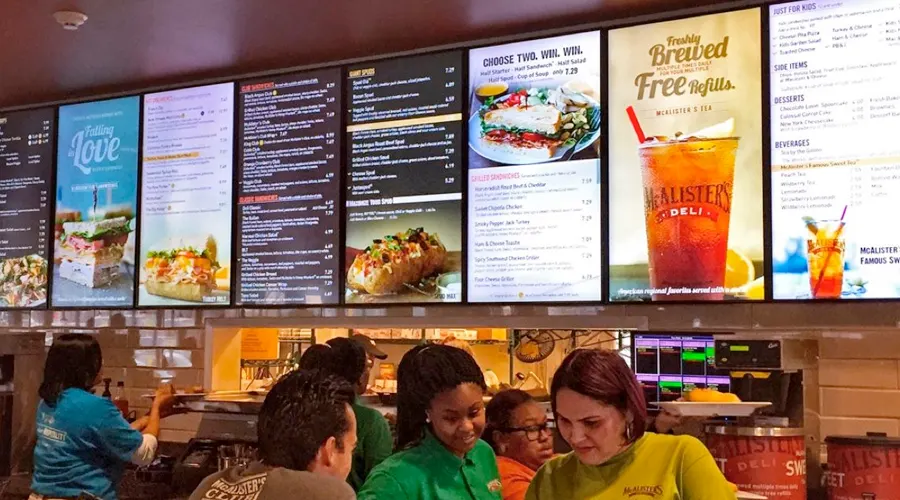
The counter should be where a QSR makes its money. A customer walks in, they are already there, already hungry, already past the decision to eat.
Everything after that moment is yours to win or lose. For most Indian quick service chains right now, the data suggests they are losing it, not to a competitor across the street, but to the experience happening at their own counter.
This post names what is actually breaking at the physical ordering point, what it costs in measurable terms, and what digital menu boards for restaurants in India are doing to close the gap. You will get two specific moves that work, the failure modes to watch in the first month, and one action you can take this week.
What a Slow Counter Actually Costs a QSR
The dine-in numbers for Indian QSRs are uncomfortable reading right now. Same-store sales growth for major chains declined 1 to 4 percent in November and December 2025, after a brief festive lift in October. Elara Securities pegged the Q4 FY26 recovery requirement at 5.3 percent SSSG just to avoid a 2.4 percent revenue downgrade. Margins have already collapsed 400 to 500 basis points across several players, with KFC and Pizza Hut both reporting negative like-for-like growth.
The delivery platforms absorb 25 to 35 percent in commissions on every order they carry. That leaves dine-in as the margin-positive channel, but only if it converts at the counter. A customer who walks in, hesitates at a cluttered static board, and leaves without ordering a combo or an add-on is real revenue that never shows up in any dashboard. At 200 covers a day across even a mid-sized chain of 30 outlets, the cumulative loss from weak counter conversion compounds into a quarterly number that is very hard to recover.
Why Static Boards and Staff-Led Upselling Keep Failing
The standard response to poor counter conversion is to train staff to upsell. The logic is sound. The execution breaks immediately at scale.
Staff turnover in Indian QSRs runs high. A new hire at a Bengaluru outlet does not consistently pitch the new mango cooler combo the way the training deck imagined. A busy Saturday afternoon means the upsell script gets skipped entirely because the queue is 12 people deep. The manager knows this is happening. There is no reliable fix because the bottleneck is human bandwidth, and that bandwidth shrinks exactly when you need it most.
Static lightbox menu boards make the same offer all day regardless of time, weather, or what is actually selling. A South Indian chain running a breakfast idli combo on the same board as their dinner biryani special creates visual noise that slows decisions rather than accelerating them. When a customer cannot read the board quickly, they default to what they already know, which means no upsell, no new item trial, and no impulse add-on. The board becomes furniture.
What Works: Match the Board to the Moment
Digital menu boards convert better when they stop showing everything and start showing the right thing at the right time.
A Delhi-based fast casual chain came to us running the same static menu board across breakfast, lunch, and dinner peaks. We replaced the boards with time-scheduled digital displays that automatically switched content blocks by daypart, featuring high-margin items photographed with local styling. Within the first quarter, their average transaction value increased by 18 percent at the two pilot outlets, driven entirely by combo attachment on items that had never previously been noticed on the old boards.
The mechanism is straightforward: a customer who sees one vivid, well-lit combo at eye level during a lunch rush makes a faster decision than a customer staring at a board listing 40 items in the same font weight. Faster decisions mean shorter queues. Shorter queues mean more covers in the same operating hour. The screen earns its space by changing what the customer sees, when they see it.
What Works: Make Promotions Visible Without Printing Anything
The second move is about speed of promotion, not just visual quality.
Static boards punish agile pricing. When a QSR wants to run a Tuesday afternoon deal to fill a slow period, the current path involves printing, laminating, replacing physical inserts across locations, and hoping the field team has executed by the time the promotion starts. Most chains run fewer promotions than they should because the logistics cost too much relative to the likely return.
A Pune-based QSR group with 22 outlets was sitting on a strong value meal at Rs 99 positioning but could only activate it during promotional windows because of print lead times. We connected their digital menu boards to a central content management system, allowing the marketing team to push price and offer changes from a single dashboard across all outlets simultaneously. They ran 11 distinct limited-time promotions in a single quarter, compared to 3 in the prior quarter. Footfall on promotion days increased 22 percent versus non-promotion Tuesdays, with no print cost involved.
The operational shift matters as much as the revenue shift: a team that can test a promotion on a Wednesday and scale it by Friday is running a fundamentally different kind of marketing operation than one that works on a two-week print cycle.
What to Watch in the First 30 Days
Three failure modes appear regularly in early digital menu board rollouts, and they are all avoidable.
Content is set once and treated as finished. The most common mistake is treating the digital board like a digital version of the old static board. A board loaded with the same 40-item grid in the same layout delivers the same weak conversion result, just on an LCD screen. The first 30 days require weekly content reviews. What are the top three selling items this week? Are they visible above the fold on the board? That discipline takes 30 minutes per week and directly affects transaction value.
The screen is installed but not calibrated for ambient light. A counter-facing board that washes out under overhead lighting at 2 PM becomes invisible at the exact moment it should be working hardest. Brightness settings need to be set by time of day, not left at factory default. We check this at installation, but if you are inheriting a system from a previous vendor, audit this before assuming the board is underperforming.
No one owns the content schedule. Digital menu boards require a content owner inside the business, one person who knows what is scheduled, when it updates, and what the board should show during a promotion. Without this, boards drift back to default content, and the commercial benefit disappears within a few months of launch.
The Specific First Action: Audit Your Two Busiest Outlets This Week
Pick your two highest-traffic outlets. Stand at the counter for 15 minutes during the lunch peak. Watch where customers' eyes go when they walk up. Count how many people order without looking at the menu at all, which means the board is not doing any work. Count how many people pause, look confused, and then order the same thing they always order.
If more than half your observed customers are not being influenced by the board, you have a conversion gap that digital menu boards can close. Book a screen audit with our team at [email protected]., and we will map your current counter setup against what a content-driven digital system would change, outlet by outlet, with estimated impact on transaction value.
Ready to scale smarter?
From listing accuracy to performance insights, we handle every detail so your marketplace runs at its best.
Ready to elevate
your brand?
Drop us a message, and let’s start
building something amazing together.